Common Jobs in the USA: 100 Most Common Jobs, Jobs for Women and Men
Common Jobs in the USA: 100 Most Common Jobs, Jobs for Women and Men
The U.S. job market includes millions of workers across healthcare, retail, education, technology, transportation, construction, hospitality, business, and professional services. Some occupations employ millions of people, while others are smaller but offer specialized career paths.
If you are researching common jobs in the USA, looking for a list of jobs in USA for ladies, exploring a list of jobs in USA for men, or simply trying to understand which careers are most common, this guide provides a practical starting point.
According to the U.S. Bureau of Labor Statistics (BLS), the largest occupations in May 2024 included home health and personal care aides, retail salespersons, fast-food and counter workers, general and operations managers, registered nurses, cashiers, laborers and freight/material movers, stockers and order fillers, customer service representatives, and general office clerks. (Bureau of Labor Statistics)
It is important to remember that “most common” does not necessarily mean “best-paying” or “best career.” A common occupation simply has a large number of workers. Your best career choice depends on your interests, qualifications, location, experience, income goals, and long-term plans.
What Is the Most Common Job in the USA?
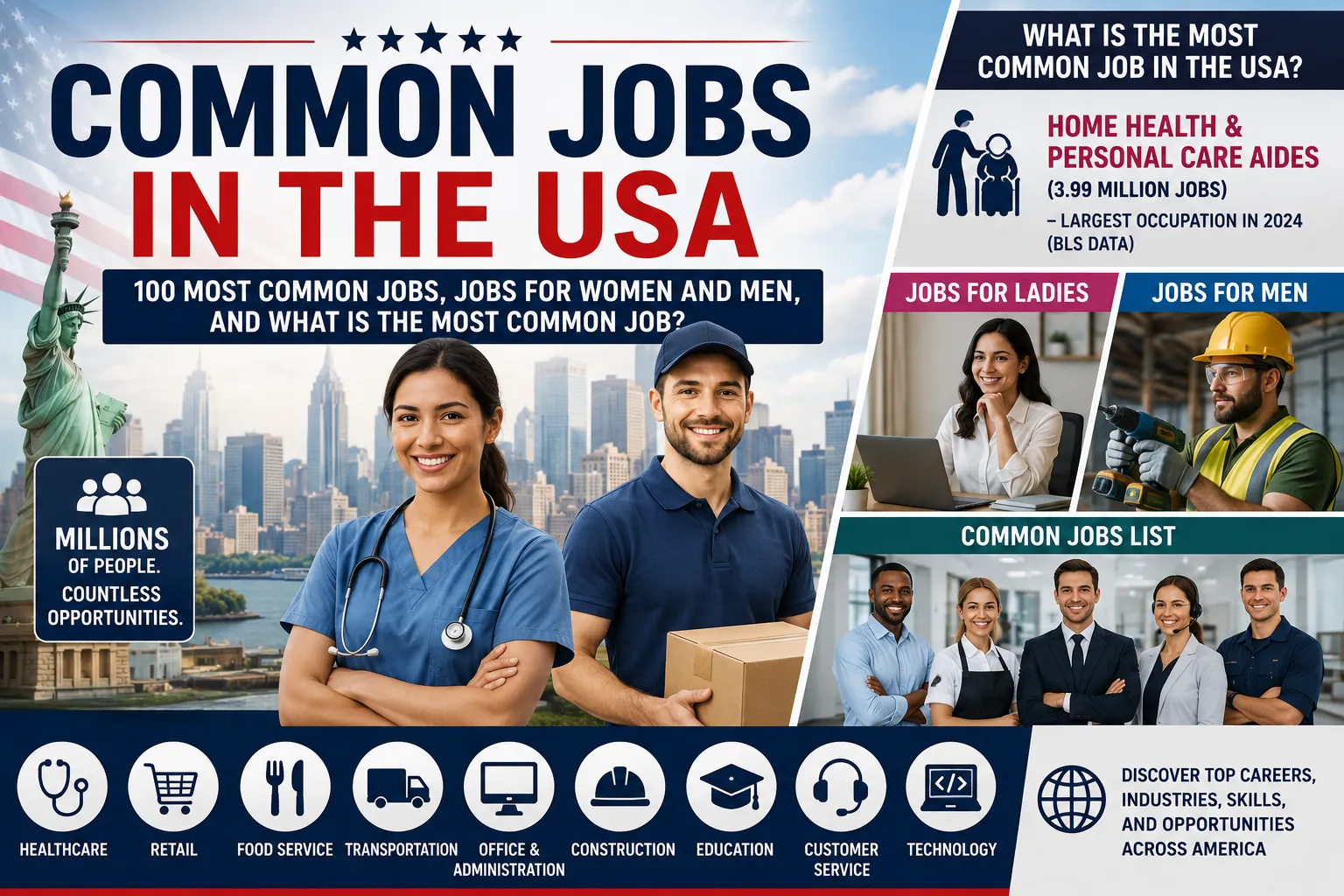
Based on the latest BLS occupational employment data used for this article, home health and personal care aides were the largest occupation in the United States in May 2024, with approximately 3.99 million jobs.
They were followed by:
- Retail salespersons — about 3.80 million
- Fast food and counter workers — about 3.78 million
- General and operations managers — about 3.58 million
- Registered nurses — about 3.28 million
- Cashiers — about 3.15 million
- Laborers and freight, stock, and material movers — about 2.98 million
- Stockers and order fillers — about 2.78 million
- Customer service representatives — about 2.73 million
- Office clerks, general — about 2.51 million
These figures come from BLS Occupational Employment and Wage Statistics and represent employment estimates rather than job openings or annual hiring totals. (Bureau of Labor Statistics)
Quick Answer
The most common occupation in the USA, based on May 2024 BLS employment estimates, is home health and personal care aide.
That answer can change as employment patterns change, so it is better to use a dated government dataset rather than claim that one occupation will always be the most common.
10 Most Common Jobs in America
If you are specifically searching for the 10 most common jobs in America, the following list provides the latest BLS-based snapshot available for this comparison.
| Rank | Occupation | Approx. Employment |
|---|---|---|
| 1 | Home Health and Personal Care Aides | 3,988,140 |
| 2 | Retail Salespersons | 3,800,250 |
| 3 | Fast Food and Counter Workers | 3,780,930 |
| 4 | General and Operations Managers | 3,584,420 |
| 5 | Registered Nurses | 3,282,010 |
| 6 | Cashiers | 3,148,030 |
| 7 | Laborers and Freight, Stock, and Material Movers | 2,982,530 |
| 8 | Stockers and Order Fillers | 2,779,530 |
| 9 | Customer Service Representatives | 2,725,930 |
| 10 | Office Clerks, General | 2,510,550 |
These jobs demonstrate how diverse the American labor market is. The list includes healthcare, retail, food service, management, logistics, customer service, and administrative work.
Why Are These Jobs So Common?
The most common occupations tend to be connected to services that people and businesses need every day.
Healthcare is a major example. Millions of Americans require assistance with daily living, medical care, and related services. Retail stores need sales staff, warehouses need stockers and material movers, restaurants need food-service workers, and companies need customer-service and administrative employees.
The BLS data also show that large occupational groups include office and administrative support, transportation and material moving, food preparation and serving, sales, management, business and financial operations, healthcare, and education. (Bureau of Labor Statistics)
In other words, common jobs are often common because the underlying services are needed across almost every community.
List of Jobs in USA for Ladies
There is no fixed list of jobs that is exclusively for women. Women can work in virtually every occupation in the United States, including technology, construction, healthcare, management, transportation, finance, engineering, and skilled trades.
However, if you are specifically searching for a list of jobs in USA for ladies, these are examples of occupations that many women pursue:
- Registered nurse
- Home health aide
- Personal care aide
- Teacher
- Elementary school teacher
- Dental hygienist
- Medical assistant
- Human resources specialist
- Administrative assistant
- Office manager
- Customer service representative
- Social worker
- Accountant
- Marketing specialist
- Graphic designer
- Web designer
- Software developer
- Project manager
- Sales representative
- Real estate agent
- Paralegal
- Pharmacy technician
- Childcare worker
- Preschool teacher
- Receptionist
BLS data show substantial female representation across professional, healthcare, service, sales, and office occupations. For example, women accounted for a larger share of employment in professional and related occupations, service occupations, and sales and office occupations in the BLS 2024 data. (Bureau of Labor Statistics)
Important: Jobs Are Not Limited by Gender
A modern job search should focus on skills, qualifications, interests, and working conditions, rather than assuming that certain careers are only appropriate for women.
A woman interested in engineering can become an engineer. A woman interested in construction can work in the trades. A woman interested in software can become a developer. Likewise, men can pursue healthcare, education, administration, childcare, and other professions.
List of Jobs in USA for Men
If you are looking for a list of jobs in USA for men, there are equally broad opportunities across almost every industry.
Some examples include:
- Software developer
- Electrician
- Plumber
- Construction worker
- Carpenter
- Truck driver
- Welder
- Mechanic
- Police officer
- Firefighter
- Warehouse worker
- Delivery driver
- Operations manager
- Sales representative
- Engineer
- IT specialist
- Cybersecurity analyst
- Accountant
- Financial analyst
- Project manager
- Real estate agent
- Chef
- Restaurant manager
- Security guard
- HVAC technician
Again, these occupations are not male-only jobs. Women can and do work in these fields as well.
BLS employment data show that men are represented across management, professional, service, sales, construction, production, transportation, and other occupational groups. (Bureau of Labor Statistics)
100 Most Common Jobs in the USA
People frequently search for a 100 most common jobs list when comparing career options. There is an important distinction, however: there is no single BLS table that should be interpreted as a definitive ranking of exactly 100 “best” or “most common” jobs.
The following is therefore a practical common jobs list, compiled around occupations that are widely found across the U.S. labor market. It is not presented as an official BLS 1–100 ranking.
Healthcare and Care Jobs
- Registered Nurse
- Licensed Practical Nurse
- Nursing Assistant
- Home Health and Personal Care Aide
- Medical Assistant
- Dental Assistant
- Dental Hygienist
- Pharmacy Technician
- Medical Records Specialist
- Social Worker
Office and Administrative Jobs
- Office Clerk
- Administrative Assistant
- Receptionist
- Executive Assistant
- Customer Service Representative
- Human Resources Assistant
- Payroll Clerk
- Bookkeeping Clerk
- Accounting Clerk
- Data Entry Clerk
Retail and Sales Jobs
- Retail Salesperson
- Cashier
- Sales Representative
- Store Manager
- Assistant Store Manager
- Sales Associate
- Merchandiser
- Retail Supervisor
- Real Estate Agent
- Insurance Sales Agent
Food and Hospitality Jobs
- Fast Food Worker
- Restaurant Server
- Cook
- Chef
- Food Preparation Worker
- Bartender
- Host or Hostess
- Restaurant Manager
- Hotel Front Desk Clerk
- Housekeeping Worker
Transportation and Delivery Jobs
- Heavy Truck Driver
- Delivery Driver
- Bus Driver
- School Bus Driver
- Taxi Driver
- Chauffeur
- Warehouse Driver
- Freight Handler
- Material Mover
- Shipping and Receiving Clerk
Warehouse and Logistics Jobs
- Stocker
- Order Filler
- Warehouse Associate
- Logistics Coordinator
- Inventory Clerk
- Shipping Clerk
- Receiving Clerk
- Forklift Operator
- Distribution Manager
- Supply Chain Specialist
Construction and Skilled Trades
- Construction Laborer
- Electrician
- Plumber
- Carpenter
- Welder
- HVAC Technician
- Mason
- Painter
- Roofer
- Construction Supervisor
Business and Professional Jobs
- General Manager
- Operations Manager
- Project Manager
- Accountant
- Financial Analyst
- Marketing Specialist
- Human Resources Specialist
- Business Analyst
- Management Analyst
- Sales Manager
Technology Jobs
- Software Developer
- Web Developer
- Computer Support Specialist
- Network Administrator
- Systems Administrator
- Database Administrator
- Cybersecurity Analyst
- Data Analyst
- IT Manager
- UX/UI Designer
Education, Public Service and Other Jobs
- Elementary School Teacher
- High School Teacher
- Teaching Assistant
- College Instructor
- Police Officer
- Firefighter
- Security Guard
- Maintenance Worker
- Janitor or Cleaner
- Landscaper
This list is intended as a broad common jobs list, not a precise employment ranking. Occupations differ greatly in size, qualifications, pay, and availability depending on the state and local labor market.
What Is the Most Common Job in the World?
This question is more difficult to answer than it appears because countries classify occupations differently, and a single global ranking of individual job titles is not maintained in the same way as U.S. occupational statistics.
The International Labour Organization (ILO) uses the International Standard Classification of Occupations (ISCO) to organize jobs across countries. The classification contains 436 detailed unit groups, which makes international comparisons possible while also showing why a simple worldwide “No. 1 job” can be misleading. (ISCO)
Agriculture is one of the largest sources of employment globally. ILO material has reported agriculture as accounting for a substantial share of global employment, while more recent international data show that agriculture’s share has declined over time as economies have shifted toward manufacturing and services. (International Labour Organization)
For that reason, agricultural work is often described as one of the world’s most widespread forms of employment, particularly when considering developing and rural economies. However, it would be misleading to claim that “farmer” is definitively the single most common job worldwide without specifying the dataset, year, and occupational classification.
Quick Answer
There is no universally accepted single “most common job in the world.” Agriculture employs a very large share of workers globally, while service, sales, and other occupations are also widespread.
The ILO notes that employment statistics are classified using internationally standardized occupational groups, making comparisons more meaningful when the same classification and dataset are used. (ISCO)
Common Jobs in the USA by Industry
Another useful way to understand the American labor market is to organize common jobs in USA by industry.
Healthcare
Common healthcare occupations include:
- Registered nurses
- Home health aides
- Personal care aides
- Nursing assistants
- Medical assistants
- Dental assistants
- Pharmacy technicians
- Medical records specialists
Healthcare is one of the largest employment areas in the country, with several healthcare occupations appearing among the nation’s largest individual occupations. (Bureau of Labor Statistics)
Retail
Retail employment includes:
- Retail salespersons
- Cashiers
- Store managers
- Sales associates
- Stockers
- Order fillers
- Customer-service workers
Retail salespersons and cashiers are among the largest occupations in the United States by employment. (Bureau of Labor Statistics)
Food Service
Restaurants, cafés, cafeterias, and food-service companies employ:
- Fast-food workers
- Counter workers
- Cooks
- Servers
- Food preparation workers
- Restaurant managers
- Hosts and hostesses
Fast-food and counter workers were among the three largest U.S. occupations in the May 2024 BLS data. (Bureau of Labor Statistics)
Transportation and Logistics
Common roles include:
- Truck drivers
- Delivery drivers
- Freight handlers
- Material movers
- Warehouse workers
- Stockers
- Order fillers
- Logistics coordinators
Transportation and material-moving occupations represented about 8.9% of U.S. employment in the May 2024 BLS occupational data. (Bureau of Labor Statistics)
Office and Business
Office-based employment includes:
- Office clerks
- Administrative assistants
- Customer service representatives
- Accountants
- Human resources specialists
- Project managers
- Business analysts
- Operations managers
Office and administrative support was the largest major occupational group in the May 2024 OEWS data, representing about 11.8% of total employment. (Bureau of Labor Statistics)
What Makes a Job Common?
A job becomes widespread for several reasons.
High consumer demand
Jobs that provide everyday services—such as healthcare, food, retail, transportation, and customer support—are needed across large parts of the country.
Large industries
A large industry naturally creates employment across many occupations. Healthcare, retail, logistics, education, hospitality, and business services all employ workers at different skill levels.
Low or moderate barriers to entry
Some large occupations do not require a four-year college degree. This can create a broader pool of potential workers.
Employment across many locations
A job found in almost every city or community will generally have more workers nationwide than a highly specialized occupation concentrated in only a few locations.
Common Jobs vs. High-Paying Jobs
One of the biggest mistakes job seekers make is assuming that the most common jobs are also the highest-paying jobs.
They are not.
For example, retail sales, food service, customer service, and office support employ millions of people, but specialized occupations in medicine, technology, management, engineering, and finance can have substantially different compensation levels.
The BLS reports employment and wage information separately, allowing job seekers to compare both the size of an occupation and its earnings. (Bureau of Labor Statistics)
If your primary goal is income, you should examine:
- Median or average pay
- Required education
- Required experience
- Licensing requirements
- Job growth
- Local demand
- Cost of training
- Work schedule
- Opportunities for advancement
A less common occupation can sometimes provide a much stronger career path than a very common entry-level job.
How to Choose From This Common Jobs List
A long list of occupations is useful only if you know how to narrow it down.
Start by asking yourself five questions:
1. What am I good at?
Think about your strongest skills. Are you good with people, numbers, technology, writing, physical work, organization, or problem-solving?
2. What education do I have?
Some jobs require a high school diploma, while others require an associate degree, bachelor’s degree, professional license, or advanced training.
3. How much do I want to earn?
Set a realistic income target and compare occupations based on median pay rather than assuming every worker earns the same amount.
4. Where do I want to work?
Job availability varies significantly between states and cities. A career that is common in Texas may have a different employment picture in New York or California.
BLS publishes occupational employment and wage estimates at national, state, metropolitan, and nonmetropolitan levels, which can help with location-specific research. (Bureau of Labor Statistics)
5. Do I want a job or a long-term career?
A common entry-level job can be useful for immediate income, but you may eventually want to move into a career with greater responsibility, higher pay, or better advancement opportunities.
Frequently Asked Questions
What is the most common job in the USA?
Based on May 2024 BLS occupational employment estimates, home health and personal care aides were the largest U.S. occupation, with approximately 3.99 million jobs. Retail salespersons and fast-food/counter workers followed closely behind. (Bureau of Labor Statistics)
What are the 10 most common jobs in America?
The 10 largest occupations in the May 2024 BLS data were home health and personal care aides, retail salespersons, fast-food and counter workers, general and operations managers, registered nurses, cashiers, laborers and freight/material movers, stockers and order fillers, customer service representatives, and general office clerks. (Bureau of Labor Statistics)
What are common jobs in the USA?
Common jobs include healthcare aides, nurses, retail salespeople, cashiers, food-service workers, managers, warehouse workers, truck drivers, customer service representatives, office clerks, teachers, construction workers, and technology professionals.
What jobs are available for women in the USA?
Women can work in virtually every U.S. occupation. Common examples include nursing, education, healthcare support, administration, customer service, accounting, marketing, technology, management, retail, and professional services. BLS data provide employment statistics by occupation and sex, rather than limiting occupations by gender. (Bureau of Labor Statistics)
What jobs are available for men in the USA?
Men can work in every major occupational group, including technology, healthcare, construction, transportation, manufacturing, management, finance, sales, education, and public service. The best occupation depends on qualifications and personal career goals rather than gender.
What is the most common job in the world?
There is no universally accepted single answer because countries use different labor-market structures and occupational classifications. Agriculture represents a very large share of global employment, while service and sales occupations are also widespread. The ILO uses ISCO to create internationally comparable occupational categories. (ISCO)
What are the 100 most common jobs?
There is no single official BLS ranking called the “100 most common jobs.” The 100-job list above is a practical collection of widely found occupations across healthcare, retail, business, technology, transportation, construction, education, hospitality, and other sectors. For exact employment rankings, use current BLS occupational employment data. (Bureau of Labor Statistics)
Which jobs are easiest to get in the USA?
Entry requirements vary by employer and location, but jobs such as retail sales, food service, customer service, warehouse work, office support, delivery, and some care occupations can have relatively broad entry-level opportunities. However, availability and requirements change by location and employer.
What are the most common jobs that do not require a college degree?
Examples include retail sales, food-service work, customer service, warehouse and material-moving jobs, delivery and truck driving, construction trades, maintenance, administrative support, and some healthcare-support occupations. Specific certifications or training may still be required for individual jobs.
Final Thoughts
The American labor market is much broader than a simple list of job titles suggests. Some occupations employ millions of people, while thousands of smaller professions serve specialized industries.
If you are searching for common jobs in the USA, the most useful place to start is by understanding what employers actually need. BLS data show that healthcare, retail, food service, logistics, office support, customer service, management, and other large service sectors account for significant portions of U.S. employment. (Bureau of Labor Statistics)
If you searched for a list of jobs in USA for ladies or a list of jobs in USA for men, remember that today’s labor market is not divided into fixed male and female careers. Your education, skills, experience, interests, and career goals matter much more than gender.
And if you were searching for the 100 most common jobs, use the list in this guide as a starting point rather than treating it as an official national ranking. Employment changes over time, and BLS regularly updates its occupational data.
Ultimately, the “most common” job is not necessarily the best job for you. The better question is: Which occupation matches your skills, offers the lifestyle you want, and gives you a realistic path toward your financial and career goals?